How to Run a Successful Trading Competition

A perp DEX puts up a prize pool to bring volume onto its book. By day three the top three places belong to wallets nobody recognizes, trading the same pair against each other around the clock. The volume is real. It counts. It is worth nothing.
What a competition buys is decided before it opens, by the number the leaderboard ranks.
Which metric to reward
A competition does not reward trading. It rewards one number, and traders optimize for that number.
Volume is the number everyone announces and the cheapest one to fake. Two wallets run by the same person trade against each other all day and post any figure you want.
PnL buys variance, and it has a one step exploit: open opposite positions on two accounts and one of them finishes up no matter what the market does.
Fees paid is the hardest to fake, because faking it means handing the exchange the money you are trying to win back. Keep the prize under what the competition collects in fees, or burning fees to win the pool turns profitable.
Open interest held buys duration and pairs well with fees. On its own it is farmable with a hedged position across two accounts.
Rank on fees, and pay part of the pool on positions held through the window.
How to structure the leaderboard
Once the metric is set, the shape of the board decides how many people compete.
1. The window. One or two weeks creates urgency and caps your exposure to any single farming strategy. Long windows favor whoever automates first.
2. The cutoff. Publish the exact timestamp that closes the window, in UTC, before the competition opens. A cutoff that moves is the fastest way to lose the argument with the trader who finished fourth.
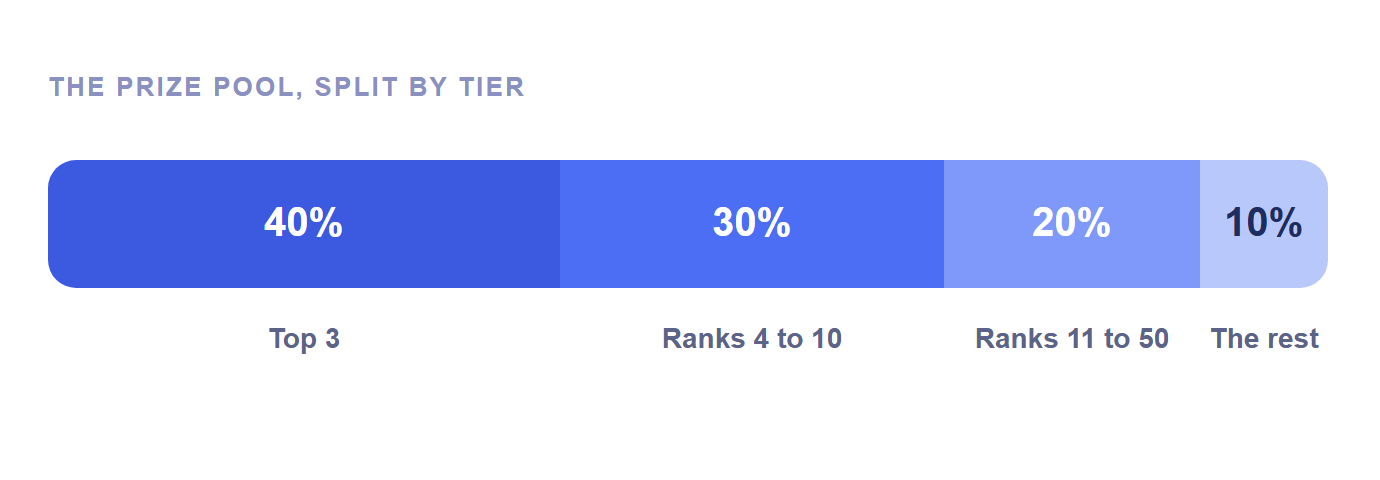
3. The tiers. Group the ranks instead of paying each position its own number: 1 to 3, 4 to 10, 11 to 50, 51 to 200. The prize should fall more slowly than the rank does, so a trader who cannot reach the podium can still reach the next tier by trading more today.
4. The spread. Winner takes most looks generous and empties the board: once one wallet is far ahead, everyone below stops trading and the volume leaves with them. Pay on share of the metric instead, with a proportional pool.
Settle after the window closes
Competitions that pay in real time give a farmer a fast loop and no window in which anyone can look at what they did. Settling on a published schedule, after the window closes, takes the loop away: the farmer has to commit capital and wait, knowing the reward may never become claimable.
Waiting also buys the room for everything in the next section. A flagged wallet that has already been paid is a clawback conversation. A flagged wallet that has not been paid yet is a decision.
Which filters run before anyone gets paid
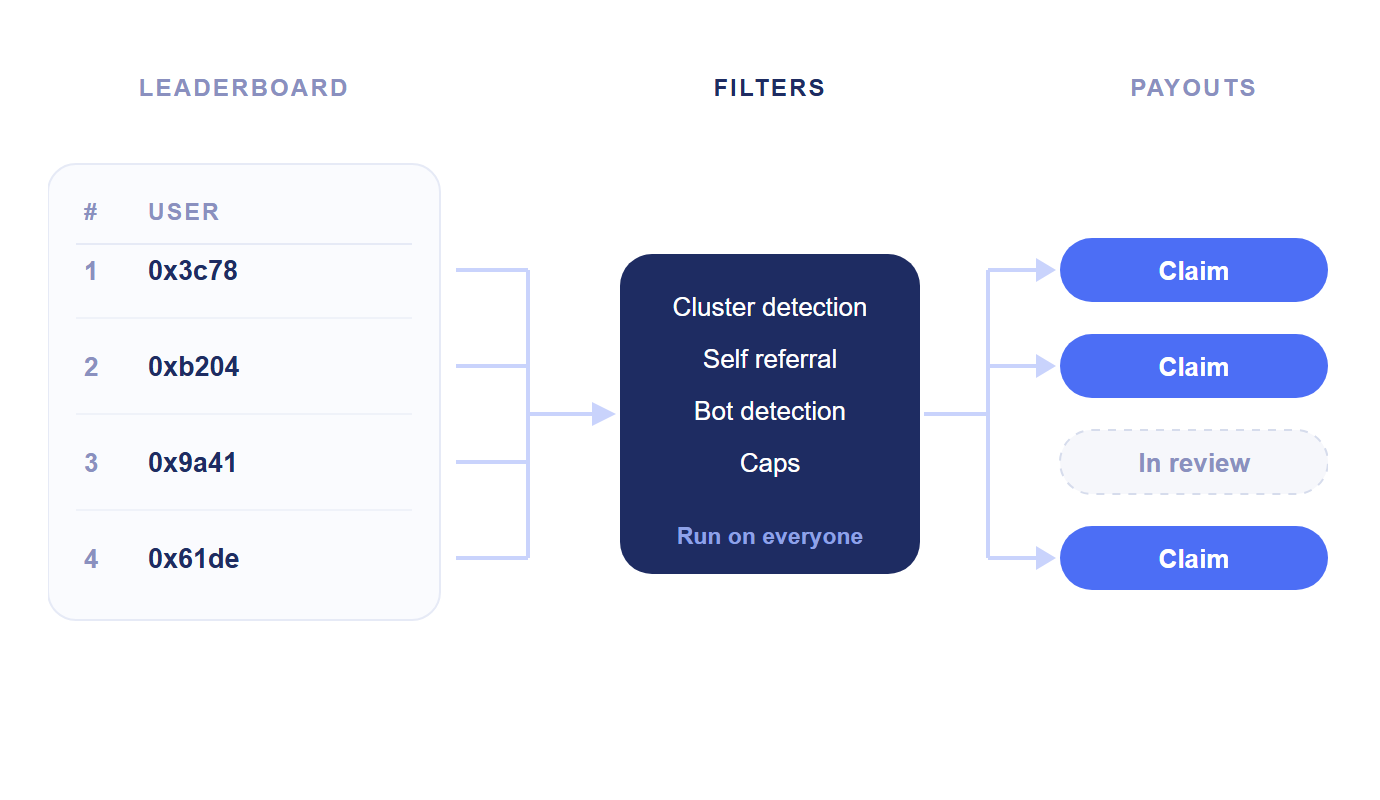
The filters are what separate the leaderboard from the payout list. Four are worth running on any competition.
Cluster detection groups wallets that look like one person, reading more than 30 onchain signals from funding sources to transaction timing. It is what catches three wallets trading against each other at the top of the board.
Self referral detection catches a referrer and an end user who share the same browser session.
Bot detection reads frontend and onchain behavior together to identify automated software.
Caps limit what one account earns in a time window, and what an affiliate earns from referrals relative to their own trading.
Whatever they catch goes to a review queue where your team approves or rejects it, and the reason stays attached to the payout.
What a competition cannot do, and what to run underneath
A competition is time boxed. It ends, and the volume it bought tends to leave with it.
Treat it as the peak of a program, not the program. What runs underneath is what keeps the traders it attracted.
A referral program that pays on fees generated.
A rate that differs by segment, so the wallet that stayed earns more per dollar than the one that arrived for the prize.
A standing reward on size held over time, at a lower budget all year.
What Fuul does
Fuul tracks the activity the competition rewards, ranks traders by volume or by fees, and pays by position or by share of a pool.
None of the filters in this post is something your team builds. They run before a payout exists, and every decision, including the rejected ones, keeps its record next to the reward. Rewards are paid from your own contract, in tokens or points.
The competition gets you the attention. The program underneath decides how much of it you keep.
If you are planning a competition, book a demo at fuul.xyz.

Leandro Schlottchauer
CO-Founder & CEO, Fuul
Passionate about building and scaling products for the next web.